
Building a vision is a lifetime’s work. That vision begins with an internal revelation; you see something, and it changes your life forever. Over time, often years, and in some cases decades, the vision comes to fruition piece by piece. Eventually, you reach the threshold toward which the previous years have been leading. There’s no turning back. Now the vision must enter the world on its own terms.
Since the publication of my article, Drawing the Pre-Raphaelites, in the Pre-Raphaelite Society’s journal, the PRS Review, last summer, I find myself in the midst of a personal and professional transition.
Over the past year, I’ve been going through the demanding process of harmoniously unifying vision and craft. This isn’t something new. It’s been building for decades and has gathered extraordinary momentum over the last few years. Reaching such a moment deserves proper recognition. A new series of drawings will acknowledge that and chronicle the maddening process of aspiring to a higher creative plane.
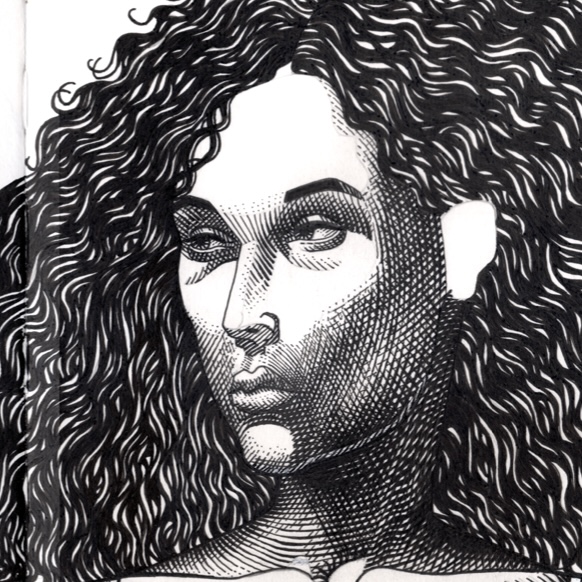
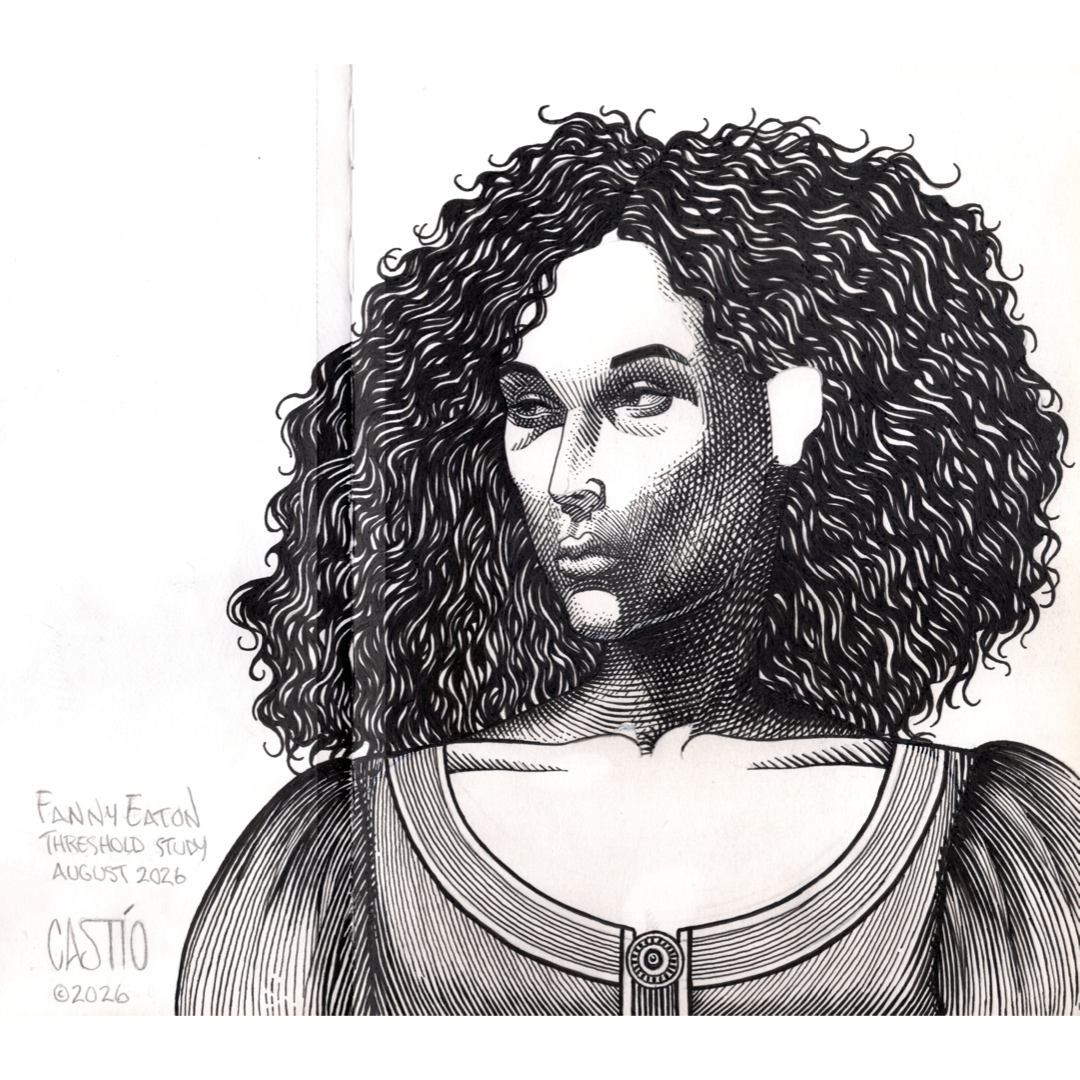
This new series began in the pages of the PRS Review with my portrait of Jamaican-born muse Fanny Matilda Eaton (1835-1924). I based my drawing of Fanny on Walter Fryer Stocks’s 1859 chalk portrait, translating his image into pen and ink. After its publication, I began to feel that there was more potential in the drawing than I had initially imagined.
Over the last few years, diversity has been discussed more frequently within Pre-Raphaelite academic circles. That’s not surprising. Diversity was present within the movement from its beginnings, including in Dante Gabriel Rossetti himself, the son of an Italian immigrant. Fanny’s story still seems to be unfolding; I suspect there is much more left to discover.
In this new series, I plan to expand my drawing of Fanny significantly as I explore stillness and psychological atmosphere. I’ve decided to modernize her appearance and attire, allowing her to move beyond the confines of the Victorian source image and assume a stronger contemporary presence as I wrestle with ideas of diversity, stillness, and transformation.
The idea for my augmented composition has evolved in the pages of my sketchbook over the past few months. Pages of thumbnails and studies, along with extensive reading, have helped me refine my image of Fanny. Together, they are helping me give Fanny a modern-day presence in a drawing that, when completed, will reflect its months-long evolution and my own decades-long transformation.