
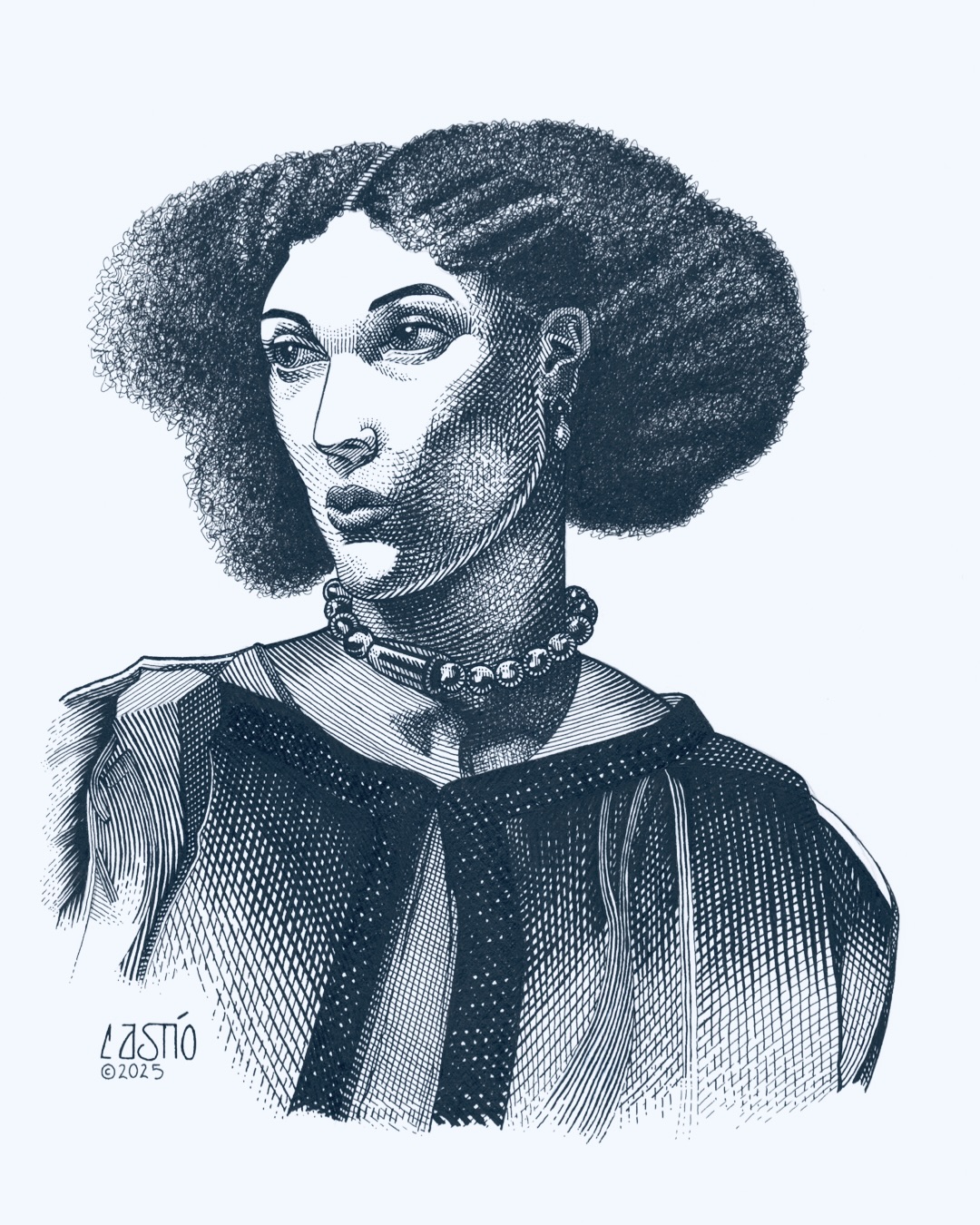
Fanny Eaton (After Fryer Stocks). 2025. Pen and ink on paper. 9″x12″.
My work is defiance on paper. I am not here to chase trends or court popularity—I am here to be myself. And being yourself means going against expectations. Declaring self-autonomy always comes with a generous cup of take it or leave it.
Over the years, I’ve come to see that defiance takes many forms—but at its core, it’s an attitude. For me, defiance has meant doing something most people are unwilling to do: playing the long game. It means pursuing a decades-long vision, holding myself to a world-class standard, embracing a global outlook, creating traditional art, and committing to black-and-white drawing in ink on paper. The recent publication of In An Artist’s Studio, an article on my work, has validated all of these things.
Defiance also lives in what you choose to draw. In recent years, I’ve been drawn to spotlight the downtrodden, the overlooked, the less valued, and the innocent victims of violence. It’s not the most glamorous path, but it resonates deeply with me. At some point, I realized there had to be more than kitchen utensils or coffeehouse patrons nursing five-dollar lattes. I pursued that for a time—but eventually, the novelty wore off. Sketchbook artist is not what I am.
Fanny Matilda Eaton (1835–1924) was a Jamaican-born, London-raised woman of color who lived in Victorian England and posed for members and associates of the Pre-Raphaelite Brotherhood. She appears in several notable works, including Dante Gabriel Rossetti’s The Beloved (1862), John Everett Millais’s The Pearl of Great Price (1860), and Simeon Solomon’s The Mother of Moses (1860), where she made her public debut. Beyond these paintings, Fanny was also the subject of numerous drawings and studies. Two that stand out are Rossetti’s magnificent pencil Study of a Young Woman (c. 1865) and Walter Fryer Stocks’s 1859 colored chalk drawing, which I used as a reference for my own portrait of Fanny.
I had long known that women of color had posed for the Pre-Raphaelites, but their names remained unknown to me. Fanny Eaton is the first Black model of the PRB whose name I’ve come to know. Her story has come into focus thanks to the investigative work of her great-grandson, Brian Eaton, who published Fanny Eaton’s Story in 2024. And yet, despite the publication of this book and a growing interest in her legacy, Fanny remains an enigma—like so many women whose lives were essential but unrecorded in the history of art.
Although some critics still try to dismiss the Pre-Raphaelites as an irrelevant niche Victorian art movement, it’s increasingly clear that the Pre-Raphaelites’ vision was broader and richer than their critiques suggest. A multicultural thread runs through their work—and through the lives of those who shaped it. Fanny is a prominent example. So is Dante Gabriel Rossetti, son of Italian immigrants and co-founder of the Brotherhood. Maria Zambaco, from London’s Anglo-Greek community, posed for many of Burne-Jones’s most iconic paintings. At the same time, her cousin, painter Maria Spartali Stillman, contributed significant works to the Pre-Raphaelite canon. All of these people have contributed to the rich, cultural, and diverse mélange that makes up Pre-Raphaelitism.
There are also quietly powerful undercurrents of LGBTQ presence and acceptance. Painter Simeon Solomon, who introduced Fanny to the public in The Mother of Moses, was part of that lineage—and contributed significantly to the Brotherhood’s visual language.
It is an exciting time for the Pre-Raphaelites and their kindred movements. As AI and digital technologies continue to proliferate, I believe the desire for traditional art—created with genuine intent and a purpose beyond commodification—will only grow. People are hungry for work that resists the algorithm, that refuses to pander to pop culture, that slows time instead of accelerating it.
It is in that quiet rebellion—in that defiance—that my work finds its place.
The portrait of Fanny Eaton in this post first appeared in the article, In An Artist’s Studio, in the summer 2025 issue of the PRS Review, published by the Pre-Raphaelite Society in the UK.
For more information on the Pre-Raphaelite Society, visit: preraphaelitesociety.org
For more information on Fanny, visit: wikipedia.org
