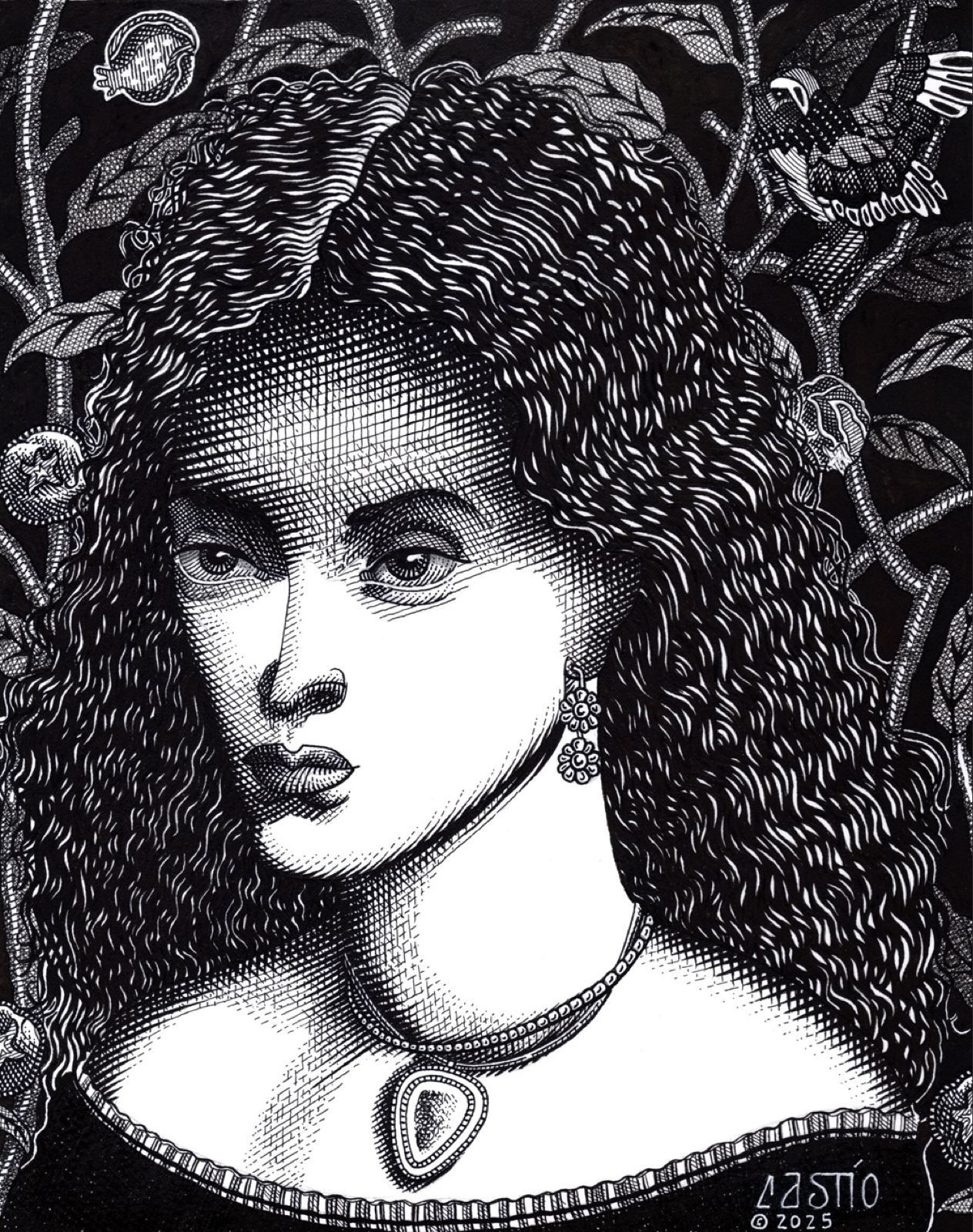
Beautiful Rebellion. 2025. Pen and ink on paper. 9″x12″.
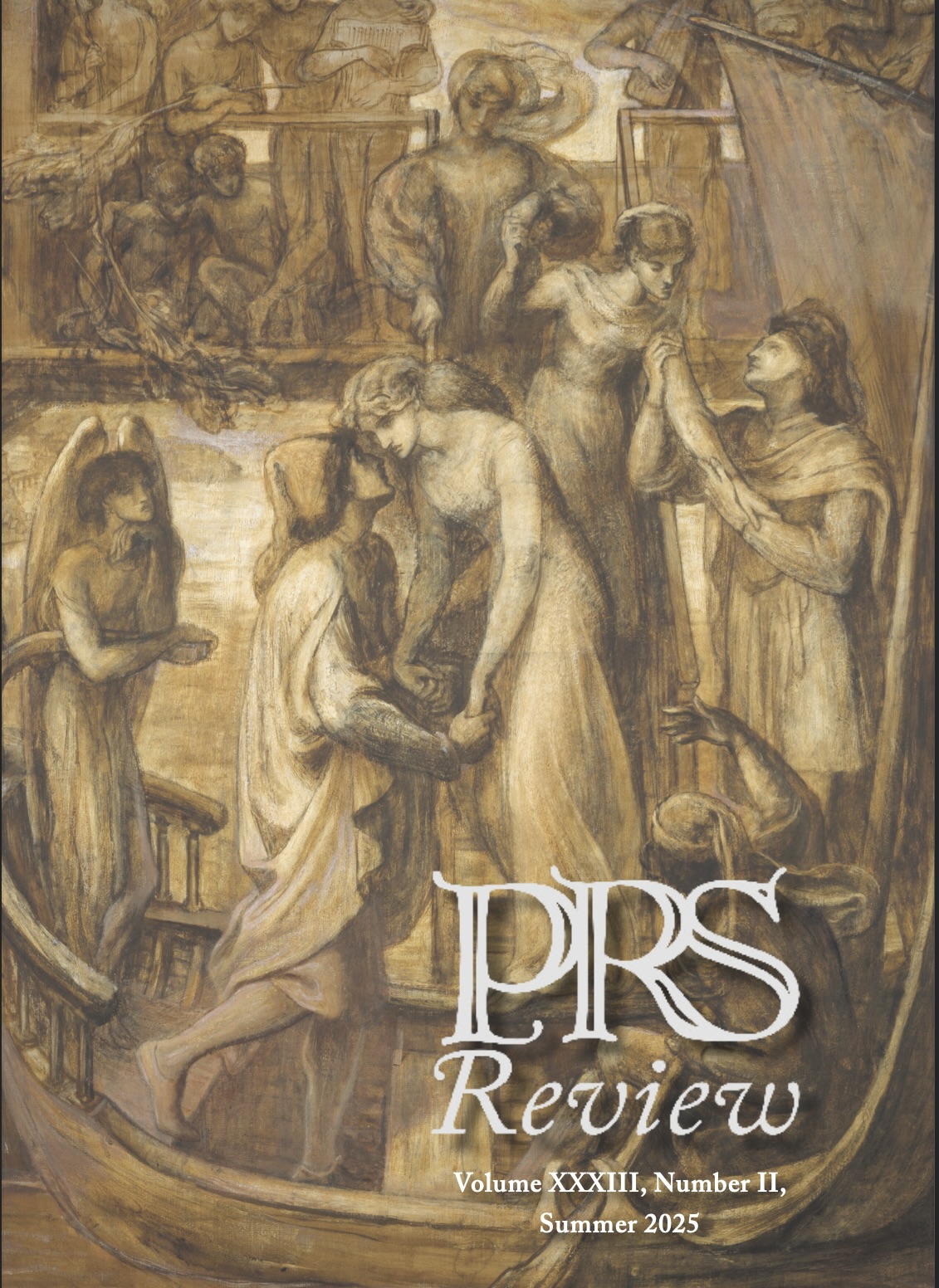
A year ago, I was mired in a creativity-crushing stasis that all but strangled my productivity. Today, that paralysis has given way to triumph: I am the subject of a six-page feature in the summer 2025 issue of the Pre-Raphaelite Society’s journal, the PRS Review. Months ago, a dear friend remarked, “This article will be your introduction as an artist. You’ve always wanted your work recognized internationally—now it’s happening.”
I’ve always believed you can’t be a prophet in your own land.
The turning point came with my drawing Mystery, created at the tail end of that long, suffocating stretch as I fought to free myself from the grip of stasis. Its completion marked a new plateau. My embrace of a Pre-Raphaelite aesthetic, which began with Entre Sombras in 2022, had reached a higher level, giving me the means to express my authentic voice. That evolution did not go unnoticed.
In March of this year, I was contacted by Dr. Zaynub Zaman, editor of the PRS Review, regarding my submission to the Society’s annual art competition. She told me that my drawing, Mystery, had not been selected, but added, “However, I loved your drawing and would like to use it for something else.” Those words marked the beginning of something far more meaningful. A few weeks later, her follow-up email arrived with an opportunity that would change everything and validate my struggles and sacrifices. She was preparing to launch a new series, In an Artist’s Studio, designed to give readers a glimpse into the creative process—and she wanted me to help introduce it.
In the end, it wasn’t about winning—it was about being seen and being understood.
Suddenly, four decades of effort and sacrifice took on new meaning. In an Artist’s Studio was originally planned as a modest two-page spread: a short introduction to my work accompanied by four drawings. The request was for 500 words, but that could never contain my decades-long obsession with the Pre-Raphaelites. After wrestling with the limitations, I reached out to Dr. Zaman, who graciously doubled the word count. That expansion gave me the room not only to chart my journey, but also to make a clear, definitive statement about who I am as an artist—something that was long overdue.
For the next three months, I waited with bated breath, wondering how the published feature would take shape and hoping my words and drawings would translate on the page. The result exceeded every expectation: six full pages showcasing my work as never before. Every line, every word, every stroke found its place. Back in March, I could never have imagined what I now hold in my hands.
The picture that adorns this post, Beautiful Rebellion, is an expression of transformation and defiance—a continuation of the path my work has taken since 2022. In that time, my art has undergone a crucial shift. I have embraced an aesthetic that allows me to speak in my authentic voice, while making clear that my work is rooted in the tradition of hand-drawn art. I draw on paper with ink; I am a draughtsman, and that will never change. As AI and digital images proliferate, the hunger for hand-drawn work will only grow. People want art made with genuine intent, work that speaks to the heart and mind, created with a higher purpose beyond commodification.
Visually, I drew inspiration from Dante Gabriel Rossetti, painter, poet, and co-founder of the Pre-Raphaelite Brotherhood. His women are unmistakable: abundant hair, full sensual lips, and that iconic heavy-lidded gaze so prevalent throughout the work of the PRB. Yet Beautiful Rebellion is layered with more than Rossetti’s influence. William Morris also enters the picture. His 1866 wallpaper design, Fruit, plays a crucial role in my drawing and its story of transformation. The thrush perched in the corner adds its own voice to the piece—an emblem of the inner fulfillment I have found through committing to this chosen path. Beautiful Rebellion is a complete statement: this is who I am.
In many ways, it stands as the clearest expression of where my journey has brought me. It carries the echoes of Rossetti, Morris, and the mythic symbols they cherished, but it also declares my refusal to bow to the belief that technology is the only way forward. That defiance—my insistence on embracing tradition and reshaping it into something through which my authentic voice can shine—is precisely what made the PRS Review feature so meaningful. Seeing my work presented in those six pages was not only validation, but also proof that the long struggle had forged something enduring.
Decades of struggle have led me here, but this is not the end of the road. In an Artist’s Studio is proof that I was right to defy compromise and hold out for world-class recognition. I have found my voice—and what comes next will not be louder merely, but undeniable.